



LIMITED-TIME SPECIAL OFFER
Basic-I Japanese eLearning Course — FREE
Limited-time offer until 31 December 2026
For complete beginners ・ Self-paced eLearning ・ Downloadable materials ・ Course Community ・ Question Form
Optional online lessons are available for an additional fee: 50 min S$30 / 90 min S$50
Request your preferred date and time through the Question Form inside the course.
12 Private 1-to-1 Zoom Lessons
+ Self-paced eLearning
Learn with a Japanese Teacher — At Your Own Pace
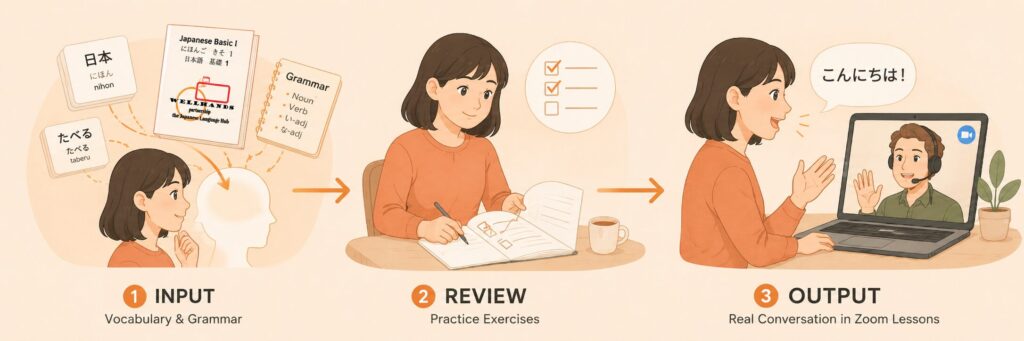
Learn directly with an experienced Japanese teacher through 12 private Zoom lessons, supported by structured eLearning you can use between lessons.
No Hiragana and Katakana Required.
You can learn Japanese without having to study or memorise hiragana and katakana(Japanese Characters) at all.
You can also choose to learn hiragana and katakana. The choice is yours.
Want to Speak Japanese?
↓
Without spending more than you need to?
↓
Want to make progress as efficiently as possible?
↓
And start with confidence — with a flexible refund option if your plans change?
Try a Free Japanese Lesson
Want to see what the course is like before you enrol? Enter your email address to watch Lesson-I 1-3: Noun Sentence - Affirmative for free.
By submitting your email, you agree to receive information from Japanese Language Hub. You can unsubscribe at any time.
Course Fee: S$322
12 private Zoom sessions + self-paced eLearning + 3 years of course access
For comparison, private lessons covering similar course content could cost around S$1,000.
Free 30-Min Consultation & Trial Lesson
Not sure which course is right for you?
Meet Keishu for a free 30-minute online consultation and trial lesson. We’ll discuss your Japanese learning goals and help you decide the best way to continue.
Your contact details will be used to arrange your free session by email or WhatsApp.
Start with More Confidence
Changed your mind or your circumstances changed?
Cancellation requests can be made within 3 months of payment. Refunds are calculated based on the course content viewed and Zoom lessons already used. For bundle purchases, individual courses may also be cancelled separately.
More Than Just eLearning
Learn at your own pace — with real support whenever you need it.
Course Community
Every course has its own dedicated Community space, where you can ask questions anytime and get support as you learn.
Question Form
If something is unclear while studying, use the Question Form to send us your question anytime.
Private Zoom Lessons
Each course includes 12 private Zoom lessons for personalised support, speaking practice and questions.
How You’ll Learn
Follow a simple 5-step learning cycle at your own pace, with support whenever you need it.
STEP 1
Download
Download Your Learning Materials
STEP 2
Watch
Watch the Lesson Videos
STEP 3
Ask
Ask Questions via the Question Form
STEP 4
Community
Post Questions in Your Course Community
STEP 5
Practise
Practise in Your Private Zoom Lesson
Does This Sound Familiar?
✓ I want to learn Japanese, but I do not know where to start.
✓ Hiragana and Katakana look too difficult.
✓ Group classes move too quickly—or too slowly.
✓ I cannot attend lessons at the same time every week.
✓ I have studied with apps, but I still cannot speak.
✓ I want to ask questions when I do not understand.
✓ I want to practise speaking with a real Japanese teacher.
My courses are designed to help you overcome these challenges and learn Japanese with confidence.
See What the Lessons Are Like
Take a look at a few sample lessons and get a feel for how the course works before you enrol.
For course details and enrolment, please select a course below.

Basic-I — S$322
For complete beginners
Includes 12 private Zoom sessions
Basic-II — S$322
Build on your Basic-I foundation
Includes 12 private Zoom sessions
Intermediate-I — S$322
Move into more practical Japanese
Includes 12 private Zoom sessions

Intermediate-II — S$322
Expand your range with more natural, practical Japanese
Includes 12 private Zoom sessions

Intermediate-III — S$322
Build confidence with more advanced everyday Japanese
Includes 12 private Zoom sessions
Private Japanese Lessons
Personalised 1-to-1 Zoom lessons
S$40 / 60 min
S$50 / 90 min
Refunds & Cancellations
Refund and cancellation requests are subject to our Refund Policy. Requests must be submitted within 3 months of payment, and the refundable amount may be adjusted based on course content viewed and Zoom lessons used. Please review our Refund Policy before enrolling.
Testimonials
I was able to build my knowledge step by step, which gave me a strong foundation
Through my lessons with Keishuさん, ...Read More

I was able to build my knowledge step by step, which gave me a strong foundation
Through my lessons with Keishuさん, I was able to build my knowledge step by step, which gave me a strong foundation and made it easier to progress from a beginner to more advanced levels. The lessons helped me understand how to use Japanese appropriately in different contexts, such as formal and informal settings. Keishuさん consistently broke down the nuances with clarity as well, making them easy to grasp as a foreign learner and whenever I faced difficulties or had questions about grammar rules, he was always prompt and thorough in his explanations.
Amber
His lessons are engaging, practical, and easy to follow, making learning Japanese both enjoyable and effective.
I’ve really enjoyed learning Japanes...Read More

His lessons are engaging, practical, and easy to follow, making learning Japanese both enjoyable and effective.
I’ve really enjoyed learning Japanese with Keishu san. His lessons are engaging, practical, and easy to follow, making learning Japanese both enjoyable and effective. I also appreciate the cultural insights he shares along the way. I would gladly recommend him to anyone looking to learn Japanese.
Nicholas
His lessons are always fun, educational, and stress-free
I have been taking lessons from Ide-se...Read More
His lessons are always fun, educational, and stress-free
I have been taking lessons from Ide-sensei for many years now. His lessons are always fun, educational, and stress-free. Ide-sensei is flexible in adjusting his lessons to respond to personalised goals instead of a one size fits all approach.
AL.
I was able to pass all JLPT up to and including N2 on my first try
The lessons were focused and interesti...Read More

I was able to pass all JLPT up to and including N2 on my first try
The lessons were focused and interesting. I was able to pass all JLPT up to and including N2 on my first try. I switched to conversational Japanese lessons after that and found the online lessons very convenient for keeping my Japanese proficiency up over the years. Highly recommended!
Victor

a very positive learning experience
I have been taking Japanese lessons with 先生 and it has been a very positive learning experience. He is patient and takes time to explain grammar and vocabulary clearly whenever I have questions. He encourages me to practice speaking Japanese without worrying about making mistakes.
I highly recommend his course to anyone interested in learning the language
Yeen Hoon(Kong)
you have been really patient
Thank you so much for teaching me, I think you have been really patient with me when I study and you also really try to connect with me and my hobbies for the lesson and I really appreciate that!
Hung
If you're looking for a professional Japanese language tutor, I wholeheartedly recommend him
I highly recommend my Japanese languag...Read More
If you're looking for a professional Japanese language tutor, I wholeheartedly recommend him
I highly recommend my Japanese language tutor; Keishu sensei for his dedication, patience, and excellent teaching methods. His lesson was engaging, and tailored to the student's learning pace. Keishu sensei explained grammar and vocabulary clearly while also introducing unique cultural insights that made learning Japanese even more enjoyable.
If you're looking for a professional Japanese language tutor, I wholeheartedly recommend him.
Franz
Keishu was patient
I was introduced to Keishu Sensei by a friend almost a year ago. Before meeting him, I had always struggled to get started with learning Japanese. Between a demanding work schedule and having forgotten where I had left off more than 20 years ago, it felt difficult to make meaningful progress.
After more than 20 years away from the language, I decided to pick it up again because I had recently married my Japanese wife and wanted to improve my Japanese as quickly as possible. Keishu Sensei came into my life at exactly the right time. He was even there to help me prepare and memorize my wedding oath in Japanese—a memory that still makes me laugh and appreciate his support even more!
From the very beginning, Keishu Sensei was patient, kind, and supportive. He took the time to walk me through the fundamentals again in a way that was easy to understand, allowing me to rebuild my foundation and regain confidence in the language.
What I appreciate most is how he encourages learning at a manageable pace. Keishu Sensei makes sure that every lesson is effective and tailored to my needs. Despite my hectic work schedule, he has always been flexible and accommodating, adapting lessons to help me stay on track without feeling overwhelmed.
If you're looking for a dedicated and understanding Japanese teacher, you'll be in very good hands with Keishu Sensei. Thank you, Keishu Sensei, for your guidance, patience, and encouragement throughout my learning journey!
- Chen Xi

“Sensei’s lessons are highly engaging and i thoroughly enjoyed them
“Sensei’s lessons are highly engag...Read More
“Sensei’s lessons are highly engaging and i thoroughly enjoyed them
“Sensei’s lessons are highly engaging and i thoroughly enjoyed them. It has helped me develop a deep interest in learning Japanese!”
Kai Wei
surprisingly accessible
Starting Japanese with Keishu sensei was surprisingly accessible — the onboarding was smooth and never intimidating. What really stood out was how he tailored each lesson to address our blind spots, making every session feel packed with exactly what I needed. The best part is being able to use what I learned at work — suddenly understanding what my Japanese colleagues are saying feels amazing, and they're always pleasantly surprised when I respond in Japanese!
Xie Peng


I passed the N-3 on my first try
I’ve been meeting with Keishu-sensei for 1-on-1 tutoring every few weeks for the past 11 years. I studied Japanese in university, and when I moved to Singapore, I wanted a tutor who would be willing to chat with me without needing to stick to a set lesson plan. Later, when I decided to take the N-3 exam and asked him for more structured sessions to prepare, he was happy to oblige and I passed the N-3 on my first try. I appreciate his adaptability and patience, and still enjoy our conversations after all this time.
Laura


Sensei is a super patient and kind teacher
Sensei is a super patient and kind teacher. Under his guidance, my conversation and listening skills in Japanese have improved and I can understand locals better whenever I travel to Japan. Sensei grounds discussions in everyday life which makes the language more applicable to experiences from day to day, and is always warm and patient about answering students' questions on grammar, sentence structures and use of vocabulary. Thank you Sensei!
TE (Ting En)
Keishu sensei is always patient with me
Keishu sensei is always patient with me despite my many mistakes. His lessons are interesting and filled with a variety of topics. Having attended his lessons for a few years now, I have improved slowly but surely. Thank you Keishu sensei!
-Charissa
I had been inspired to continue learning Japanese
From the moment I started taking Japan...Read More

I had been inspired to continue learning Japanese
From the moment I started taking Japanese lessons from Keishu Sensei, I had been inspired to continue learning Japanese, through his structured approach to learning Japanese grammar and vocabulary, as well as the fun practice conversations which we engage in every lesson. As a student in Japan now, lessons with Keishu Sensei have given me a strong grasp of the language and a solid base of which I can build off in my Japanese language journey.
Frederick

Overall, my progress has exceeded my expectations
"I began learning Japanese with Ide-se...Read More
Overall, my progress has exceeded my expectations
"I began learning Japanese with Ide-sensei in 2023 and have been taking weekly private lessons for about three years now. I started as a beginner with only basic knowledge of kana and kanji, and almost zero vocabulary. Overall, my progress has exceeded my expectations for what could be achieved with relatively limited contact hours. A huge reason for this is probably due to sensei's patience, commitment to seeing his students improve, and his highly structured approach. Highly recommended for serious students of Japanese!"
Daniel, Singapore
Beyond textbook grammar, he teaches colloquial, everyday speech and cultural context
I’ve been taking one-to-one lessons ...Read More
Beyond textbook grammar, he teaches colloquial, everyday speech and cultural context
I’ve been taking one-to-one lessons with Keishū-sensei for a while now, focused on speaking and listening, and it’s been excellent. Lessons are conducted entirely in Japanese, and he speaks at natural, everyday pace rather than slowing down for the learner — which forces real listening comprehension rather than a comfortable simulation of it. Grammar coverage goes from intermediate through advanced, up to JLPT N2 level, even though I have no intention of sitting the exam; I learn purely out of interest, mainly to maintain conversational Japanese useful for travel. Beyond textbook grammar, he teaches colloquial, everyday speech and cultural context, which matters more for actual conversation than exam-style Japanese does. I’ve become noticeably more conversant since starting. Strongly recommended for anyone wanting genuine spoken fluency rather than certificate-chasing.
Paul Kevin Cheong
This is a delightful experience of my Japanese learning journey!
From the lesson, I learnt Japanese sta...Read More
This is a delightful experience of my Japanese learning journey!
From the lesson, I learnt Japanese starting from casual daily discussion and knew how to share my point of view with classmates, which is precious because verbal communication is slightly different from formal grammar. We also follow step by step grammar structure that help us build a concrete knowledge of how tenses are used. Sensei also patiently answered everyone questions and review from time to time. This is a delightful experience of my Japanese learning journey!
HsiaoHan
Sensei Keishu provides tailored assistance to each of his students
Sensei Keishu provides tailored assist...Read More
Sensei Keishu provides tailored assistance to each of his students
Sensei Keishu provides tailored assistance to each of his students, including me. from N4 until N2, he was there to guide me to prep for the JLPT, and provided me with insights to the Japanese culture too!
~ Aidan
An amazing Japanese sensei!
Keishu Sensei is an amazing Japanese sensei! Our lessons feel like chatting with a friend about food, travel, and current events, but with the added benefit of expert guidance. He is incredibly skilled at introducing vocabulary and grammar in context, making complex concepts easy to grasp. An absolute 10/10 teacher!
Angeline


Overall, strongly recommended!
Ide sensei is awesome!
Lessons with him have been well-paced. As a...Read More
Overall, strongly recommended!
Ide sensei is awesome!
Lessons with him have been well-paced. As a busy working professional, I was worried about how much time I could dedicate to Japanese classes but Ide sensei worked with my availability and I felt no pressure whatsoever.
He was also open to trying various methods of teaching and makes an effort to individualize the content of conversations. As a result, lessons have always been engaging.
Overall, strongly recommended!
Kenji
Senei is very patient and can explain every lessons in details
It’s a wonderful class.Senei is very...Read More

Senei is very patient and can explain every lessons in details
It’s a wonderful class.Senei is very patient and can explain every lessons in details.Sensei himself is a Japanese so you don’t need to worry about your improvement.He even provide you the excellent chapters step by step.I recommend you to join sensei’s classes.10 out of 10.
Justin

I’m amazed by how much I’ve improved
I’ve been learning Japanese with Keishu San for the past three months, and I’m amazed by how much I’ve improved. He always uses the knowledge we’ve learned to have conversations with me, which has helped me apply what I’ve studied in real situations.
He also encouraged me to keep a Japanese diary, and it’s been a very effective way to strengthen my vocabulary and grammar. Thanks to his patient and easy-going teaching style, I now feel confident using Japanese when I travel in Japan, such as ordering food and making reservations. I highly recommend his lessons!
Rebecca
The lessons were well structured engaging and easy to follow making it enjoyable to build my language skills step by step
Taking the Japanese course with sensei...Read More
The lessons were well structured engaging and easy to follow making it enjoyable to build my language skills step by step
Taking the Japanese course with sensei Ide have been a rewarding experience. The lessons were well structured engaging and easy to follow making it enjoyable to build my language skills step by step. The instructor was patient and supportive creating a comfortable learning environment. I feel more confident in using Japanese in everyday situations and would highly recommend this course to anyone interested in learning this language.
Shirley
I felt more confidence in more Japanese learning and felt like I was properly making steps towards my goal.
Ever since I started having lessons wi...Read More
I felt more confidence in more Japanese learning and felt like I was properly making steps towards my goal.
Ever since I started having lessons with keishu sensei. I felt more confidence in more Japanese learning and felt like I was properly making steps towards my goal. He helps to push my skills forward and find new and fun ways to teach which makes learning engaging. After starting my lessons. My skills has improved, being able to understand, read and listen Japanese on my own.
Richard
We find him to be a very patient, dedicated, knowledgeable, kind n pleasant teacher.
We have been learning conversational J...Read More

We find him to be a very patient, dedicated, knowledgeable, kind n pleasant teacher.
We have been learning conversational Japanese with Keishu Sensei for some time. We find him to be a very patient, dedicated, knowledgeable, kind n pleasant teacher. He’s also very accommodating n always punctual. He’s very helpful n friendly. We’re indeed happy to have him as our teacher.
Chuan & Lye Kuen

His lessons are engaging, fun and enjoyable!
My 15 lessons with Keishu sensei flew by so quickly. His lessons are engaging, fun and enjoyable! Thank you for your kind patience ありがとうございました 🙇🏻♀️
Wen Jing
What You’ll Be Able to Do at Each Level
Basic-I — What You’ll Be Able to Do
By the end of Basic-I, you will be able to:
- Build basic Japanese sentences using nouns, verbs, i-adjectives and na-adjectives.
- Introduce yourself and share basic personal information.
- Use common Japanese greetings in everyday situations.
- Count numbers and say years, months, dates, days of the week and time.
- Ask basic questions using common question words.
- Talk about what you do, do not do, did and did not do.
- Describe people, places and things using adjectives.
Basic-II — What You’ll Be Able to Do
Basic-II
By the end of Basic-II, you will be able to:
- Say when an activity starts and ends.
- Describe movement from one place to another.
- Explain the purpose of going somewhere.
- Invite someone to do something together.
- Describe the existence and location of people and objects, such as:
“There is a cup of coffee on the table.” - Compare two or more people, places or things.
- Describe the features and characteristics of people, places and objects.
- Form and use the te-form of Japanese verbs.
- Use the te-form to make requests, describe ongoing actions and express other common ideas.
There are five key verb forms in Japanese:
- Te-form
- Masu-form
- Dictionary form
- Ta-form
- Nai-form
In Basic-II, you will begin with the te-form. Your study of the te-form will continue in Intermediate-I.
Intermediate-I — What You’ll Be Able to Do
Intermediate-I
By the end of Intermediate-I, you will be able to:
- Use a wider range of expressions with the te-form.
- Form and use the five key Japanese verb forms: te-form, masu-form, dictionary form, ta-form and nai-form.
- Use the ta-form to talk about past experiences and express meanings such as “when” and “if.”
- Use the masu-stem to express what you want to do, explain how to do something and describe something as easy or difficult to do.
- Use the nai-form to ask someone not to do something.
- Express obligation, such as “must do” and “have to do.”
- Use the dictionary form to talk about things you sometimes do.
- Use the dictionary form to explain things that you are able to do.
Intermediate-II — What You’ll Be Able to Do
Intermediate-II
By the end of Intermediate-II, you will be able to:
- Use the potential form to talk about what you can and cannot do.
- Use the volitional form to express your intentions and plans.
- Use relative clauses to give more detailed information about people, places and things.
- Use nominalisation to turn actions and ideas into noun-like expressions.
- Use sentence structures that emphasise particular actions or information.
- Recognise and use imperative and prohibitive forms for strong commands in appropriate situations.
- Use conditional and hypothetical expressions to talk about “if” situations.
In Japanese grammar, relative clauses is more accurate than “relative pronouns,” because Japanese does not use relative pronouns such as who, which or that in the same way as English.
Intermediate-III — What You’ll Be Able to Do
Intermediate-III
By the end of Intermediate-III, you will be able to:
- Make suppositions and guesses based on what you see, hear or observe.
- Use the passive form to describe actions from the receiver’s point of view.
- Use the causative form to express making or allowing someone to do something.
- Use the causative-passive form to describe being made to do something.
- Understand how passive and causative structures change the perspective of a sentence.
- Use Japanese honorific language in business and formal situations.
- Use respectful and humble expressions when speaking to customers, senior colleagues and people of higher status.
- Communicate with greater accuracy and flexibility in more complex situations.
You will also learn many other useful expressions for everyday communication.
SAVE MORE WITH A COURSE SET
Planning to continue your Japanese journey?
Choose a Course Set and save more than purchasing each course separately.
Complete 5-Course Set
Basic-I → Intermediate-III
SG$1,288.00
Start from zero and follow the complete learning path through approximately JLPT N4 level.
4-Course Set
Basic-II→Intermediate-III
SG$1,094.80
Continue from Basic-II and build your Japanese step by step through approximately JLPT N4 level.
Intermediate 3-Course Set
Intermediate-I → Inter.-III
SG$869.40
Build stronger intermediate Japanese and progress through the complete Intermediate programme.
Intermediate 2-Course Set
Intermediate-II and -III
SG$611.80
Take your intermediate Japanese further and complete the final two courses in the programme.
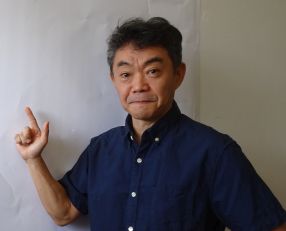
Meet Keishu, Your Japanese Teacher
- 20+ years of teaching experience
- Beginner to advanced learners
- Private Zoom support included with eLearning courses
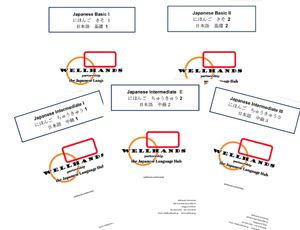
About the Textbooks
Designed from over 20 years of teaching experience
Keishu created the course materials to introduce Japanese step by step, focusing on one grammar point at a time so learners can build a clear and practical foundation.
- Clear, step-by-step explanations
- Practical examples for everyday Japanese
- Designed to support self-paced learning and Zoom lessons

1.
Beginner-Friendly
Start from the basics with clear, step-by-step lessons. You can begin even without memorising hiragana or katakana.

2.
Ask questions Anytime
If something is unclear while studying, use the Question Form or Community to ask for help instead of staying stuck.

3.
You're Not Alone
Your course includes private Zoom lessons, so you can practise speaking, ask questions and receive personalised support.
Language Learning and Brain Health
Research has explored possible links between bilingualism, cognitive reserve, and healthy ageing. However, learning a language has not been proven to prevent or treat dementia.